Friday, February 20, 2009

My Grandfather, World War I and ALOT of Bureaucratic Red Tape


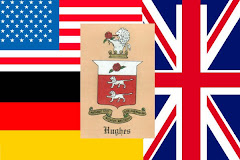
My parental grandfather, George Henry Hughes, was born in West Hartlepool, England on March 19, 1898. In 1906 the family immigrated to the United States and began their new life on the South Side of Pittsburgh, Pennsylvania. Sometime around 1915, when the Jones & Laughlin Steel Company opened a new plant, called the Aliquippa Works, down the Ohio River from Pittsburgh, in Woodlawn, Pennsylvania, the Hughes family moved.

When the United States entered World War I, George was most anxious to serve. He immediately went to the nearest recruitment office and as the family story goes…he was rejected for active duty due to his poor eyesight. One might say that my grandfather was “hell bent” to serve, and decided if the Americans wouldn’t take him, that he would take a train up to Toronto, and enlist there.

Sergeant George Henry Hughes
World War I
Canadian Expeditionary Force


On August 1, 1917, George Henry Hughes mustered into the Canadian Expeditionary Force as a member of the 20th MGC (Machine Gun Company). He was trained on the Vickers Machine Gun and received his sergeant strips. What can I say….the US Army rejected him due to poor eyesight and the Canadians trained him on a machine gun!!!

I know of some of his service experiences as a letter that he wrote to his foreman at American Bridge Company (where he was employed as a draftsman) found its way into a local newspaper.

Following training his company was to be shipped to France, but at the last minute, Great Britain decided to send them to Siberia—Vladivostok, Russia. He saw a small amount of gunfire in Harbin, China, but was primarily stationed in Vladivostok.

George was honorably discharged on May 16, 1919 and returned to Woodlawn, Pennsylvania.


While Grandfather was serving in World War I, his father, John George Hughes, had made application for United States citizenship. Also listed on the application were his wife, Elizabeth, and his son, George.


When George returned from the war, his father went to court to be certain that George was a United States citizen since he had sworn allegiance to the King when he enlisted in the Canadian Expeditionary Force.

John died before the court acted on his petition, so Elizabeth and George continued the court process and in 1923, the court assured George that he was indeed a United States citizen.

George married the love of his life, had three successful children and a rewarding, lifelong, career as a draftsman for The American Bridge Company.

In the late 1950’s, my grandfather was preparing to retire and he and my grandmother were making plans to cruise around the world and relocate to St. Petersburg, Florida. Both applied for their passport. Imagine the look of shock and horror when George found out that he was NOT a citizen of the United States and could not apply for an American passport! He had been living in the US for over 50 years, paying taxes and voting and was not a citizen! My father poking good natured fun at his father, called him “the alien” which was not met with humor in return.

Apparently the court ruling of 1923 was rescinded, but no one bothered to tell my grandfather. The process began again. After filing numerous papers to no avail, my grandfather finally received his citizenship through a rider to a congressional bill, added by Congressman Robert J. Corbett, from the 29th district in Allegheny County, Pennsylvania. It read, “George Henry Hughes received his citizenship on December 12, 1918.”


My grandfather’s certificate of citizenship is dated April 6, 1962 and the plans for the trip around the world were a success.

Links on Flipside to Additional Blogs


Thursday, February 19, 2009

The Proverbial Genealogy Brick Wall


I saw this idea on a website, probably somewhere on genabloggers. Write about your genealogy brick walls and the names will be listed on google. Then if there are family members out there and they google their names or their ancestors names, your blog will come up.

What a great idea!!!! So here goes….Please meet my granduncle

ALBERT L. FREDERICK
1. I have also seen his name as Bert L. Frederick in the obituary of his mother in 1909.

2. He is the son of Alfred Frederick and Lucinda Orr Frederick.

3. He was born on July 29, 1869 in Franklin Square, Columbiana County, Ohio.

4. He may have been a shoe salesman and may have purchased Smith & Strock goods in Leetonia, Columbian County, Ohio in 1894.

5. He may have married first, Mabel Hendricks on November 28, 1889 in Columbiana County, Ohio.

6. A daughter was born to this union named Larrie Fredericks on September 18, 1890.

7. Mabel Hendricks Frederick died on February 12, 1899.

8. There is an old Frederick handwritten genealogy notebook done around 1909-1911 listing that Albert had a son named Raymond.

9. There is a 1910 census in Chicago, Illinois for a Burt L. Frederick married for a second time. His second wife is listed as Louise and a daughter Sarah born abt 1907 in Illinois. Burt is working as a yard master for a freight yard.

What works and what doesn’t

1. The information about the shoe salesman and marriage to Mabel Hendricks could be another Albert Frederick. The marriage certificate is signed Albert H. Frederick and my Albert was listed in an obituary as Bert L.

2. There could have been two Mabel Fredericks in Columbiana County, Ohio at this time.

3. I have not been able to locate a census report for 1900, 1920 or 1930.

4. My mother never remembers anyone talking about her Uncle Albert. She was born in 1921, so Burt could have died in the 20’s or early 30’s while she was still young.

5. The fact that the 1910 Bert Frederick is working for a freight yard fits with his father and brother, Robert. Both worked with railroads.

6. The Albert Frederick listed in the 1910 Chicago census had been married twice.

7. Albert’s middle initial could have been misprinted in the newspaper obituary.

The photograph is circa 1886. It is a professional group shot of the Frederick children and I have cropped Albert out. He would have been about 17.

Wednesday, February 18, 2009

Wordless Wednesday--The VanGilder sisters

Sarah Margaret VanGilder Hughes (Sally) and Jessica Virginia VanGilder Rootes (Ginger)

Two sisters enjoying a piece of cake after the bridge game in 1963, probably in Akron, Ohio. I wish one of those pieces was coming my way!!!! Sarah is my grandmother and Ginger is my grand aunt.

This photo ALWAYS makes me smile!

Tuesday, February 17, 2009

Tombstone Tuesday--John Mann


John Mann, fifth child born on February 18, 1880 to Michael and Mary Ann Butson Mann, in Brandon Colliery, Durham County, England. He was crushed to death on December 9, 1918 during a mine collapse at the Burley Mines, Carroll Township, Cambria County, Pennsylvania.

I was actually on a mission to find John Mann’s burial site for my good English friend, Heather. She lives near the town where my Hughes family resided in England and spent countless hours working in libraries to find my roots. The only branch of her family that immigrated to the states was the Mann family, so I was thrilled to be able to reciprocate. To make matters even more interesting, her 2nd great grand uncle, Michael Mann is reputed to be the first person who was killed in the Great Johnstown Flood of 1889. John Mann would be her 2nd cousin twice removed. Does anyone hear the words…ROAD TRIP !!!

My traveling companion, my brother Ken, and I headed east to Johnstown, PA. Ken knows just about everything involving the Great Johnstown Flood. He already had the several day trip all planned out and we saw it all. We even tried to find the area where Michael Mann was probably swept into the flood waters as they reached South Fork, PA.


On the final day we drove up to Patton, PA and the site of Fairview Cemetery, where John Mann is buried. It didn’t take us too long to locate the tombstone and the original marker.


The Mann family were miners in England. It appears that the father, Michael and perhaps the oldest son, Joseph came to Cambria County, PA, leaving the remainder of the family in England. Following Michael’s untimely death in the flood, the remainder of his children slowly immigrated to the states and all of them ended up within a two county area of each other in Pennsylvania.

John, also a miner, married Margaret Ann Frost on April 14, 1900 in England. John, Margaret and son, John L. immigrated to the port of New York on Jan 29, 1912 on the ship Laconia. Two other children were born before John’s death, daughters Dorothy and Mary. Following John’s death, Margaret and the children returned to England.

Saturday, February 7, 2009

Frum Cemetery Revisited--Graveyard Rabbits Carnival

Over at Graveyard Rabbits the May 2009 edition of the GYR Carnival will focus on cemetery preservation. Articles could discuss tips and tricks used in preservation, projects in your area, tips for starting a project, what you've done to help preserve cemeteries or gravestone, what you'd like to do for an old or abandoned cemetery in your area, or anything else you can think of related to the topic of preservation.

During the summer of 1995, we did return to the Old Frum Cemetery. This time we were prepared and came with some tools for cleaning up the mess and to try to get tombstones back together. The family was already down in Morgantown for the annual VanGilder Reunion held at the Winfield Community Center, Winfield District, Marion County, West Virginia.

We spent several hours picking up trash, throwing broken tree limbs over a nearby ravine, cutting back weeds and up righting the fallen tombstones.


It was a labor of love! At that time I wished that we all lived closer and could spend more time working to restore our old family cemetery.

Family members who gave a hand in August 2005:

Linda Hughes Hiser
Ted Hiser
Garrett Hiser
Ken Hughes
Jeff Hughes

Wednesday, February 4, 2009

THE OLD FRUM CEMETERY or Linda following the Yellow Brick Road


      This blog has been copied from my genealogy journals and updated to include more recent research. The original was written back in the summer of 1995. I look back on the original and smile to myself as technology for genealogy research was in it’s infancy in 1995, and any discovery over the net was very exciting. I guess that excitement at discovery hasn’t changed…LOL 

     Back in the early days I was in constant correspondence with a distant cousin and premier researcher, Dr. Robert Poole Wilkins. Robert was a history professor and had done some incredible research into our mutual roots in the Morgantown, West Virginia area. Unfortunately, he did not use a computer, so we had to communicate the old fashioned way—by snail mail. I was interested to find the cemeteries where my 4x great grandparents, Sampson Smith Frum and Elizabeth VanGilder Frum were buried. Robert was not certain of the location. At that time I was heavily involved with various roots e-mail listings and one day, from out of the ether, came a response from a gal in Morgantown. She was willing to do a little poking around in the local library to see if she could find my Frums. Talk about a random act of kindness!!!! 

    To say that she was successful would be an understatement. There was a listing done in 1939 for the Old Frum Cemetery outside the city of Morgantown and there rested my Frum roots. Can you say---ROAD TRIP! 

    In June, 1955, we piled into the car and headed to Morgantown for several days. Just before leaving, my contact e-mailed me some rather rough directions….but you genealogists, we have a sixth sense for rooting out a cemetery!!! Following our check-in at the motel, lunch on High Street, and some browsing in the Morgantown shops, we started out the Kingwood Pike (also known as route 81.) The Morgantown city limits end at the Harner Chapel (land donated by a 2x great uncle.) At this point we set the mileage counter in the car and traveled on the Kingwood Pike for 2.2 miles to a crossroad. We turned right and followed dirt and rutted road, past farms and woods. No cemetery appeared. Suddenly I recognized a name on the mailbox--Maxine Wise--a relative on the Pool side. In need of HELP, I pulled in and rang the bell. A smiling, distant cousin came to the door. Maxine had known I was coming from my Internet friend. 

     She told us to turn around and follow the road across the Kingwood Pike and stay on it until we came to Aaron Creek Road. At the bottom of the hill we were to turn left onto Aaron Creek Road and drive until we saw the large white Harner farm (WOW, more relatives)! The Harner's extended the old southern hospitality beyond the call of duty!! Peggy McClure Harner actually escorted us to the home of Dayton Wiles who was currently the owner of the property where the Old Frum Cemetery was located. Dayton showed us the best way to make the ten minute hike down over the hill from Route 81. 

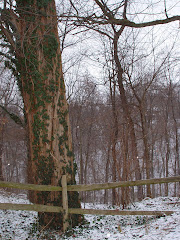
     This spot is exactly slightly less than 1.2 miles from Harner's Chapel. It is in a relatively open wild field next to the trailer home before you come to what is now called the Old Kingwood Pike Road. Our little band of five carefully climbed over the dilapidated barbed wire fence onto Dayton's land. We followed the fence as it wound through knee high weeds and wild flowers, into deep woods and finally out to grazing pastures. Once we arrived at the pasture, the Old Frum Cemetery literally emerged to our right. Nestled in a shaded wood overlooking Aaron Creek we found the remains of our ancestors. I felt like Dorothy running toward The Emerald City as I approached this plot of land. It had taken over two years of long distance research and at times frustrating work to finally locate it.


     The cemetery was partially surrounded by a rusted iron fence. One piece of the fence has been torn down and the majority of the cemetery had been vandalized. Emotions were mixed--elation at finally discovering this seemingly lost portion of our heritage and sorrow at the absolute violation of our ancestor’s final resting place. Tombstones had been knocked over and broken, weeds abounded, and cows had used the ground as their private toilet.


     We found Ann Frum Pool's (my paternal great great grandmother) tombstone laying on the ground.  The men were able to prop it up near the base.   It is a large monument which she shares with her one year old daughter, Margaret L. Pool, who died in 1849.


     Sampson S. Frum's (my paternal great great great grandfather), marker is near his daughter, Ann Frum Pool. Although his stone has weathered and is barely legible, a carved "tree of life" is visible above his name. Since there are no military markers in this private cemetery, I have to guess that the War of 1812 citation mentioned in the 1939 cemetery book is written at the bottom of the stone. 


     My paternal great great great grandmother, Elizabeth VanGilder Frum's, tombstone was broken into three pieces and lying beside her husband, Sampson.  Weathering and destruction have made her stone almost impossible to read. 

     The importance of the government's program to catalogue cemeteries in the 1930's and 1940's is certainly evident in the Old Frum Cemetery. Without that printed information, much of this portion of my history would be lost. 

      The earliest grave in the cemetery is Elizabeth Vangilder Frum which dates back to 1845. It is important to note that the cemetery is located on what was a piece of Sampson Frum's property along Aaron Creek and was designated by him to hold the remains of his family. In reviewing the Morgan Magisterial District map from 1886, this is the piece of land that Sampson willed to his daughter, Ann Louise Frum Pool. 

     The reading of the cemetery in 1939 showed that there were only 20 marked graves and 5 unmarked. The other Frum's are Alpheus and Jane Frum, their young children and one grandchild. The Pool's are descendants of Ann Louise Frum Pool. Adjacent to the main Frum Cemetery is a smaller one enclosed by a fence made of chicken wire. The graves are those of Alpheus Jerome Pool, his daughter in law, Martha E. Poole, her young son, Arnold Poole and others that I could not see from outside the fence. 

     It is my understanding from Peggy McClure Harner that the Old Frum Cemetery was on Pool property up until the time that the Harner's purchased it. We entered the property on Dayton Wiles' property, but may have crossed onto Harner land as we approached the cemetery. The property divisions were not clear to me. I would imagine that any brave descendants who wished to also make this pilgrimage would be welcome. Dayton told us that he never heard of his neighbors shooting anyone crossing the land (his attempt at humor!) 

     Reflecting on the sad condition of the Old Frum Cemetery, I only wish that it could be restored. Apparently there are other family grave sights in the Morgantown area that are sorely in need of repair and descendants have taken it upon themselves to clean them up. It would be a lasting tribute to our ancestors if we could "pool(e)" our resources and restore the Old Frum Cemetery. 

    More Currently: My brother Ken and I returned to the Old Frum Cemetery in 2007 ago during a trip to Morgantown. From the Old Kingwood Pike, there is no longer access. The property owner has put up a high impenetrable barbed wire fence. We did not explore an entrance from the Aaron Creek side of the property. 

     Recently, I have also located an obituary for Alpheus Frum. In 1901 when he died, the Old Frum Cemetery was called the Bell Cemetery. Where that name came from is unknown to me since only Frum’s owned the property up until Alpheus’ death. 

     In 2020, I was contacted by the owner of a house beside the cemetery. He and his wife have done clean up of the area.

*********************

Listings on the Internet: The Old Frum Cemetery, USGenWeb Archives, Monongalia County, West Virginia, 1966 http://files.usgwarchives.net/wv/monongalia/cemetery/cem0001.txt Old Frum Cemetery, 


Updated:  March 2025

Monday, February 2, 2009

In the Beginning--THERE WAS GENEALOGY


In 1991 we purchased our first computer, although at the time I couldn’t, for the life of me, understand why we needed one. My husband was so proud of himself knowing that his family would now be connected to the Internet and the valuable resources of cyberspace.

After linking the various wires to the components, two of us sat down in front of the screen, he pushed the “on” button and nothing happened. Talk about shock and amazed….a totally blank screen. Ted was furious and took the entire contents of all the boxes back to the computer store. Long story short, there was no hard drive in the hard drive!!! At this juncture, my skepticism as to why we needed this contraption was heightened beyond belief.

Getting connected to the net, once we had a hard drive was even more perilous….it took several weeks and since it came in through our phone lines, we missed many important calls. My only thought was, “What was Ted thinking?”

This was the era of roots, spurred on by the immensely popular TV show. Both of my kids had to do projects on their genealogy. Clueless, I turned to old stuff I had collected from both of my folks. I realized my sons would probably have the worst roots project in their classroom as I could only go back to my grandparents! I have to admit now that I love to scrapbook and do a project….whenever I was not doing well in a class myself, the project usually pulled me up….I was certainly not going to let my two boys fail.

After two roots projects for my two sons in their respective schools, I was hooked. Days spent in genealogical libraries, scrolling through microfilm, making copies of pages in books and filling in countless family charts. The housework suffered. Then came the realization that I could do some of my research on the Internet and the computer became my new best friend. The frosting on the cake…. there was a genealogical program called Family Tree Maker that I could load and do all my record keeping, print out charts….simply amazing.

Thus began my total obsession with researching my family….and Ted’s family and anyone who needed their family researched. Hit a brick wall on one of my branches; go find another family to work on. Cemeteries became my favorite haunt (no pun intended) and obituaries some pretty interesting evening reading.

An so it continues, what began as a new computer and two school projects for my kids has segued into sixteen years of genealogical bliss. Writing this blog and thinking back to 1991, it is truly amazing what can now be found on the web and how much effort all fellow genealogists have done to get it there.